Project Overview
Race Replay AI: Understanding Our Users
As part of our Software Engineering Project with IBM, we conducted comprehensive user research to understand the needs and expectations for an AI-powered F1 commentary system. Our project aims to replay OBD-II telemetry data with real-time, F1-style commentary generated by IBM Granite.
🎯 Project Objective
Build a time-series playback engine that feeds OBD-II data into IBM Granite AI to generate immersive, real-time F1-style commentary such as "Driver hits 6,500 RPM—late braking into turn 3!"
Graphical Interface Preference
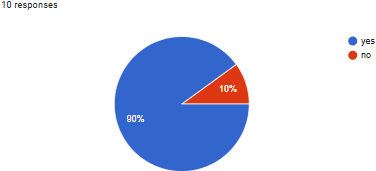
Would a graphical interface be desired by you beyond moving forwards and backwards through an audio recording?
📊 Analysis
Key Finding: The overwhelming majority (9 out of 10 respondents) desire a visual interface beyond simple audio playback. This validates our decision to implement synchronized graphs showing RPM, speed, throttle, and other telemetry data.
💡 Design Implication
Users expect a rich, visual experience. Our application must prioritize:
- Real-time telemetry visualization (RPM, speed, throttle, brake pressure)
- Track position display
- Interactive controls for playback (play, pause, speed adjustment)
- Visual feedback synchronized with audio commentary
Commentary Style Preference
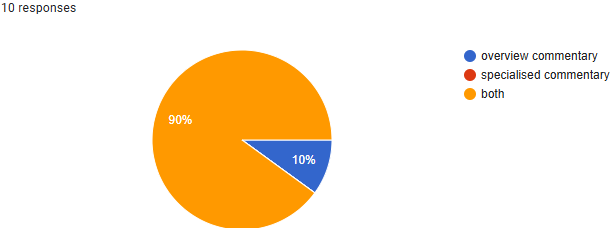
Would you want specialised commentary for each driver, an overview commentary or would both be used by you?
📊 Analysis
Key Finding: Users overwhelmingly prefer a dual-mode system offering both overview race commentary and driver-specific analysis. Only 10% would be satisfied with overview commentary alone, and notably, zero respondents want only specialized commentary.
💡 Design Implication
This demands a sophisticated, switchable commentary system:
- Overview Mode: Race-wide narrative covering battles, strategy, and key moments
- Driver Focus Mode: Detailed analysis of individual driver performance, technique, and telemetry
- Seamless Switching: Users should be able to toggle between modes or even hear both simultaneously
- Context Awareness: IBM Granite must understand when to provide race-wide context vs. driver-specific insights
Technical Challenge: Our AI commentary engine needs to maintain context for both the overall race state and individual driver performance metrics simultaneously.
Data Complexity & Presentation
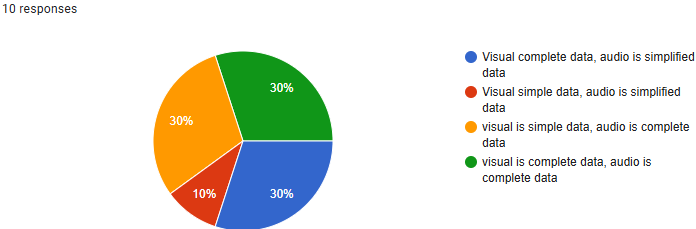
Would you rather more precise, complicated data or simpler easier to read information to be given?
📊 Analysis
Key Finding: The responses are perfectly split into three equal camps (30-30-30), with only 10% wanting fully simplified data. This reveals diverse user expertise levels and use cases.
💡 Design Implication
The split preferences indicate we need a configurable, tiered system:
🎯 Casual Fan Mode
Visual: Simple, clean graphs with key metrics
Audio: Accessible commentary focusing on excitement and narrative
📊 Enthusiast Mode
Visual: Comprehensive telemetry with multiple data streams
Audio: Balanced technical and narrative commentary
⚙️ Engineer Mode
Visual: Full technical readouts, raw data access
Audio: Deep technical analysis of every parameter
Implementation Strategy: User preference settings that independently control visual complexity (graph detail level) and audio commentary depth (technical vs. narrative focus).
Additional User Requirements
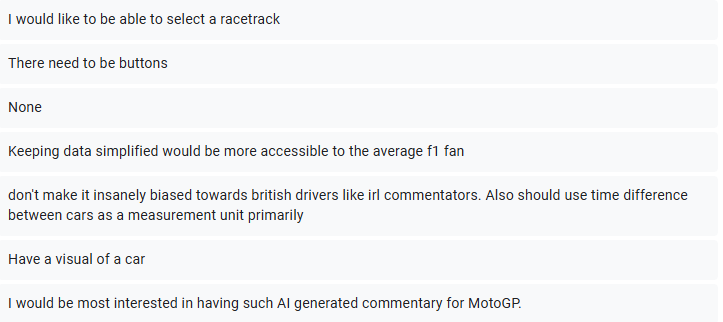
What other requirements, if any, do you have?
📊 Analysis
7 open-ended responses revealed several critical feature requests and concerns:
🏁 Race Track Selection
"I would like to be able to select a racetrack"
Implication: Users want to choose specific circuits for replay analysis. We need a track selector UI and multiple circuit datasets.
🎮 Interactive Controls
"There need to be buttons"
Implication: Clear, intuitive UI controls are essential. Play, pause, speed control, and timeline scrubbing must be prominent and responsive.
♿ Accessibility Focus
"Keeping data simplified would be more accessible to the average f1 fan"
Implication: Reinforces the need for configurable complexity. Default to accessible mode with option to enable advanced features.
🌍 Unbiased Commentary
"Don't make it insanely biased towards british drivers like irl commentators. Also should use time difference between cars as a measurement unit primarily"
Implication: AI commentary must be neutral and data-driven. Use objective metrics (time gaps, delta times) rather than subjective narratives. Critical for IBM Granite prompt engineering.
🏎️ Visual Car Representation
"Have a visual of a car"
Implication: Consider adding a 3D car model or track map with car positions for enhanced immersion.
🏍️ Multi-Sport Support
"I would be most interested in having such AI generated commentary for MotoGP."
Implication: Design system architecture to be sport-agnostic. OBD-II data structure is similar across motorsports, making expansion feasible.
Anticipated Use Cases
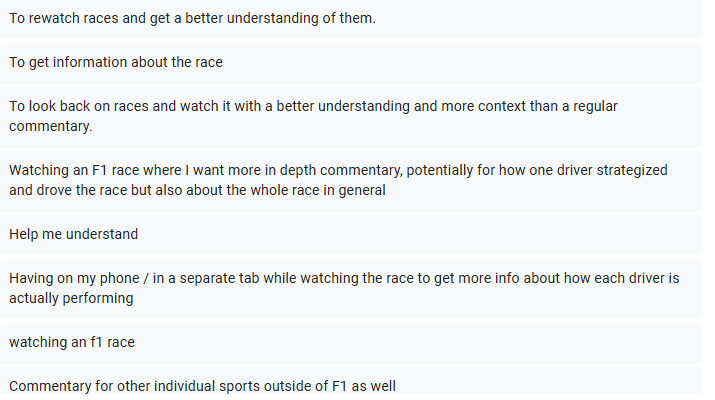
How can you imagine using this product?

📊 Analysis
10 detailed responses reveal three primary use case categories:
🎬 Enhanced Race Rewatching
"To rewatch races and get a better understanding of them."
"To look back on races and watch it with a better understanding and more context than a regular commentary."
"watching an f1 race"
User Need: Fans want to revisit races with deeper technical insight than broadcast coverage provides. Our AI commentary can reveal strategy, telemetry patterns, and technical decisions invisible to traditional coverage.
📚 Learning & Analysis
"Watching an F1 race where I want more in depth commentary, potentially for how one driver strategized and drove the race but also about the whole race in general"
"Help me understand"
"To get information about the race"
"Keeping data simplified would be more accessible to the average f1 fan"
User Need: Educational tool for understanding F1 strategy, racecraft, and technical aspects. Perfect for newer fans wanting to learn or experienced fans seeking deeper analysis. The AI can explain "why" decisions were made based on telemetry.
📱 Second Screen Experience
"Having on my phone / in a separate tab while watching the race to get more info about how each driver is actually performing"
User Need: Real-time companion during live races. Users want simultaneous broadcast viewing with supplementary technical data and AI analysis. Implies need for live data ingestion and multi-device support.
🏁 Beyond F1
"Commentary for other individual sports outside of F1 as well"
User Need: Interest in applying AI commentary to other motorsports and individual sports. Validates building a flexible, sport-agnostic architecture.
🎯 Primary Personas Identified
The Analyst
Wants deep technical understanding, strategy breakdowns, and data-driven insights. Uses product to study races post-event.
The Learner
Newer to F1, seeking accessible explanations of what's happening and why. Values simplified visual data with educational commentary.
The Live Companion User
Watches live races with app as second screen for real-time technical data and alternative commentary perspective.
Key Insights & Product Direction
Strategic Takeaways from User Research
Visual Interface is Essential
90% demand rich visual telemetry beyond audio. Our MoSCoW "Should" requirement for synchronized graphs is actually a Must Have.
Dual Commentary Mode Required
90% want both overview and driver-specific commentary. Single-mode systems won't satisfy users. IBM Granite must support context switching.
Configurable Complexity Levels
Split preferences (30-30-30) mean one-size-fits-all fails. Implement user profiles: Casual, Enthusiast, Engineer modes.
Track Selection Feature
Users explicitly requested circuit choice. Add track selector UI and support multiple circuit datasets (Monza, Silverstone, Spa, etc.).
AI Bias Awareness Critical
Users are sensitive to commentary bias. Ensure IBM Granite prompts enforce objective, data-driven narration using time gaps and telemetry, not subjective opinions.
Educational Value
Multiple users want to "understand" and "learn". Commentary should explain the "why" behind telemetry patterns (e.g., "Early braking suggests low tire grip").
📋 Revised MoSCoW Requirements (Post-Survey)
Must Have
- Time-series playback engine with OBD-II data
- IBM Granite commentary generation
- Synchronized telemetry graphs (RPM, speed, throttle, brake) Upgraded from Should
- Dual commentary mode (overview + driver-specific) New
- Playback controls (play, pause, speed control) New
Should Have
- User complexity profiles (Casual/Enthusiast/Engineer) New
- Track/circuit selection New
- Timeline scrubbing for navigation
- Data export functionality
Could Have
- Audio narration (TTS for commentary)
- Multi-driver simulation
- Track map with car positions
- 3D car visualization
- Live race companion mode
Won't Have (This Version)
- Real F1 telemetry (licensing constraints)
- Multi-sport support (F1 focus first)
- Mobile app (web-first approach)
🏁 Conclusion
Our user research validates the core concept while revealing crucial feature requirements we hadn't initially prioritized. The consistent demand for visual richness, commentary flexibility, and configurable complexity will drive our technical architecture decisions moving forward.
By centering our development around these user insights, we ensure our AI-powered F1 commentary system delivers real value to F1 enthusiasts of all experience levels.